
Marine & Outdoor Display Modules — High-Brightness Options
On a flybridge or a building façade, 1000 cd/m² is where charts and menus stop washing out. RONEN offers 23 modules at or above 1000 cd/m² (topping out at 1500 cd/m²) from 3.4″ to 21.5″, with wide-temperature and bonded-touch options for wet, sealed enclosures. ODM adds anti-glare cover glass and heated windows on request.
- 23 modules ≥1000 cd/m², up to 1500 cd/m²
- Sizes 3.4″–21.5″ — helm displays to outdoor totems
- Anti-glare cover glass and sealing options via ODM
Reading a Screen on Water at Midday
Sea and sky are the brightest natural scene a display will ever face. A sunlit white deck reflects several thousand candelas per square metre, and the water adds a specular highlight that can exceed 100,000 lux at a low sun angle. Under that load the limiting factor is rarely the backlight alone: the black level is set by what the front surface reflects back at the viewer.
The working numbers, at 100,000 lux ambient:
| Front surface | Reflectance | Reflected luminance | Panel needed for ~5:1 |
|---|---|---|---|
| Glossy, no treatment | 5% | ~1,590 cd/m² | ~6,400 cd/m² — not achievable |
| Anti-glare etch | 2% | ~640 cd/m² | ~2,500 cd/m² — above this range |
| Anti-reflective coated glass | 0.8% | ~255 cd/m² | ~1,020 cd/m² — inside this range |
| Bonded AR glass plus 1500 cd/m² | 0.8% | ~255 cd/m² | ~5.9:1 — readable with margin |
Two conclusions follow. First, the 23 modules here all sit at or above 1000 cd/m² because that is the point where an AR-coated front becomes sufficient — below it, even a good coating leaves the image grey at noon. Second, the coating is not optional: a 1500 cd/m² panel behind untreated glass performs worse than 1000 cd/m² behind AR glass, at higher cost and higher heat.
Condensation Is a Temperature Problem, Not a Sealing Problem
A sealed enclosure does not prevent condensation; it traps it. Air sealed in at assembly carries moisture, and the first cold morning puts the inside of the front glass below the dew point. At 30 °C and 80% relative humidity — an ordinary tropical morning — the dew point is about 26 °C, so any surface cooler than that fogs.
Three approaches, in order of robustness:
- Desiccant plus a sealed cavity. Works for a service life of a few years if the seal is genuinely hermetic and the desiccant is sized for the cavity volume. Once saturated, it stops working silently.
- A breathable membrane vent. Equalises pressure without letting liquid water in, so the cavity follows ambient humidity instead of trapping a sealed pocket. This is the usual choice for enclosures that see daily temperature cycles.
- Heat the glass. A transparent heater or a small heater behind the panel keeps the inner surface above the dew point. It costs power and needs a thermostat, but it is the only approach that works on demand — and it doubles as a de-icer on a cold bridge.
Salt, Fasteners and the Parts You Cannot See
Salt mist attacks the assembly long before it attacks the panel. The visible failure is a corroded bezel; the expensive one is a corroded connector or a stainless screw that has galled into an aluminium insert. Practical specification points:
- 316 stainless, not 304. The molybdenum content is what resists chloride pitting; 304 fasteners on a coastal installation show rust bloom within a season.
- No dissimilar-metal couples. Aluminium housing plus stainless screw plus salt water is a galvanic cell. Use isolating washers or matched materials.
- Conformal coating on the driver board. The panel itself is sealed; the PCB behind it is not, and a coated board survives the humidity that a bare one fails on.
- Test to a named standard. ASTM B117 neutral salt spray or IEC 60068-2-52 cyclic mist, with the duration written into the requirement — “salt resistant” without a duration is not a specification.
Helm, Flybridge, Transom: Three Positions, Three Panels
| Position | Size | Luminance | Touch | What decides it |
|---|---|---|---|---|
| Helm / chartplotter | 10.1″–15.6″ | 1000–1500 cd/m² | CTP, wet-finger tuned | Sun off the water at a low angle; spray on the glass; night dimming to single digits |
| Flybridge repeater | 7.0″–12.1″ | 1000–1500 cd/m² | CTP or sealed keys | Fully exposed — UV, salt and direct rain; the enclosure carries the IP rating, not the panel |
| Cabin / transom status panel | 3.4″–7.0″ | 500–1000 cd/m² | Usually none | Shaded but humid; condensation control matters more than brightness |
UV, Yellowing and the Front Surface
Sunlight degrades polymers, and the front of a display is usually a polymer somewhere: a polariser film, an anti-glare hard coat, a polycarbonate window. Polycarbonate yellows visibly within a few years outdoors; acrylic is more stable; glass is unaffected but heavier and breaks. The polariser itself is the part most often overlooked — a standard polariser behind a UV-transparent front will yellow from the edges inward, and the symptom is a display that looks warm-tinted at the border and normal in the middle.
For a permanently exposed position, specify a UV-blocking front (glass with a UV cut, or a coated window) rather than relying on the panel alone, and keep the polariser out of direct UV. Where the design cannot avoid it, plan the front as a consumable and make it replaceable.
The Range at a Glance
All 23 modules are at or above 1000 cd/m². The two smallest diagonals exist because instrument repeaters often need a readable number more than they need area.
| Size | Models | Resolutions in this range | Panel / touch variants | Where it usually goes |
|---|---|---|---|---|
| 3.4″ | 1 | 800×800 | IPS Round 1 | Cabin gauge |
| 3.5″ | 1 | 320×240 | IPS 1 | Compact status panel |
| 3.9″ | 1 | 480×128 | IPS Bar 1 | Cabin display |
| 4.3″ | 2 | 480×272 | TN 1 / IPS 1 | Status panel |
| 5.0″ | 3 | 800×480 | IPS 2 / TN 1 | Compact helm display |
| 7.0″ | 4 | 800×480, 1024×600 | IPS 3 / TN 1 | Helm repeater |
| 8.0″ | 1 | 800×600 | TN 1 | Helm instrument |
| 10.1″ | 3 | 1280×800, 1920×1200 | IPS 3 | Chartplotter |
| 10.4″ | 1 | 1024×768 | IPS 1 | 4:3 chartplotter retrofit |
| 12.1″ | 2 | 1024×768, 1280×800 | IPS 2 | Chartplotter |
| 15.6″ | 2 | 1920×1080 | IPS 2 | Large helm display |
| 18.5″ | 1 | 1920×1080 | IPS 1 | Bridge monitor |
| 21.5″ | 1 | 1920×1080 | IPS 1 | Bridge / outdoor totem |
Standard Modules in This Range
23 standard models in this family
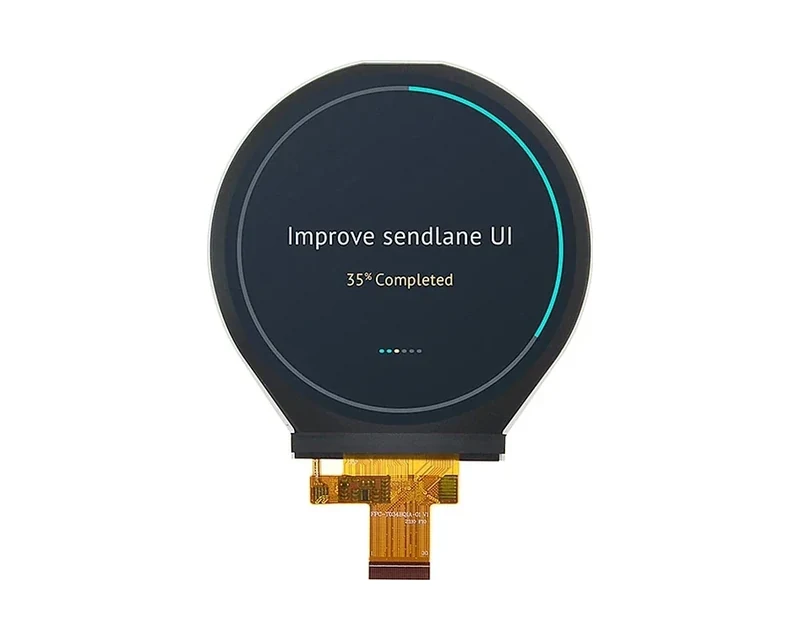
RG-T034BOIA-01
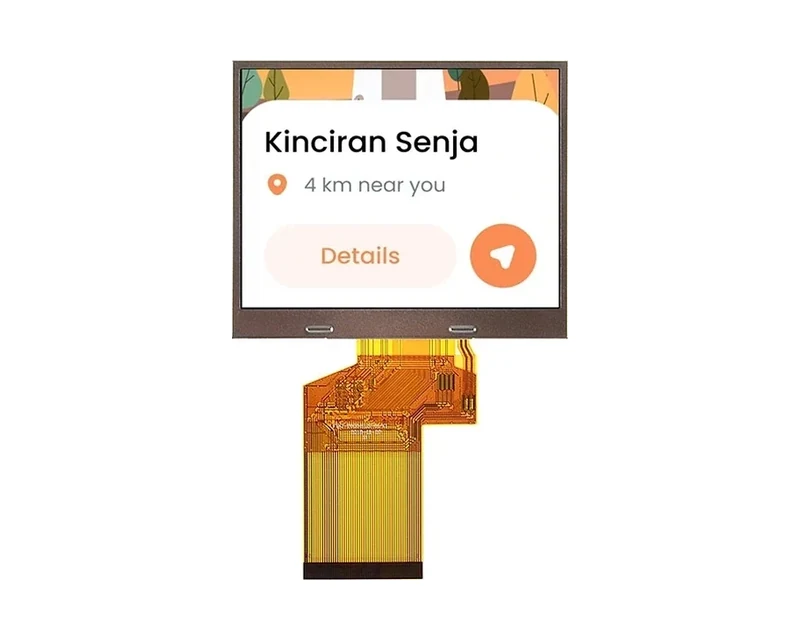
RG-T035HLSWA-01
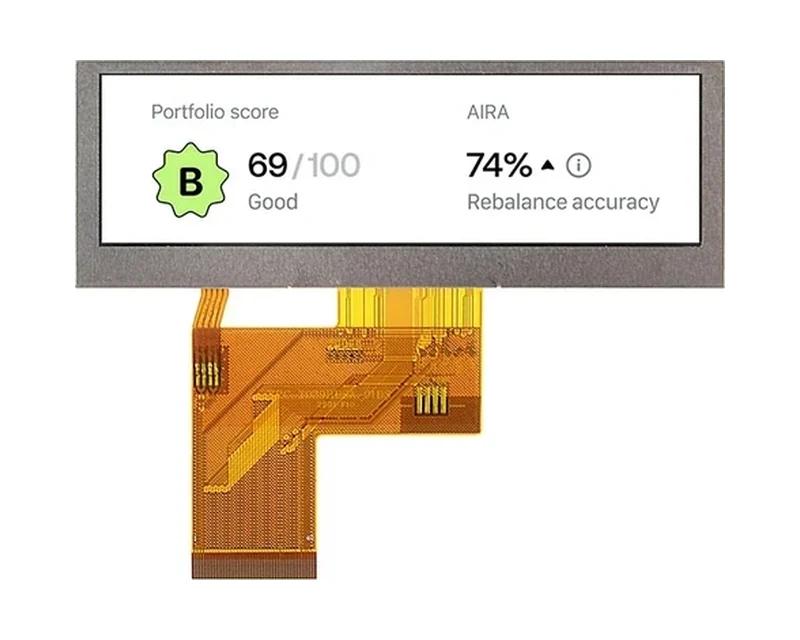
RG-T039BPSA-01
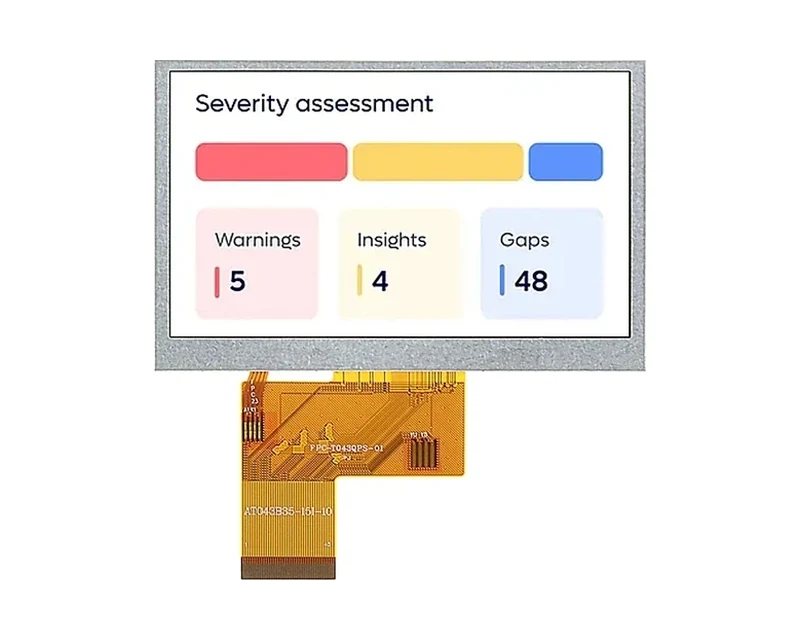
RG-T043QPS-02
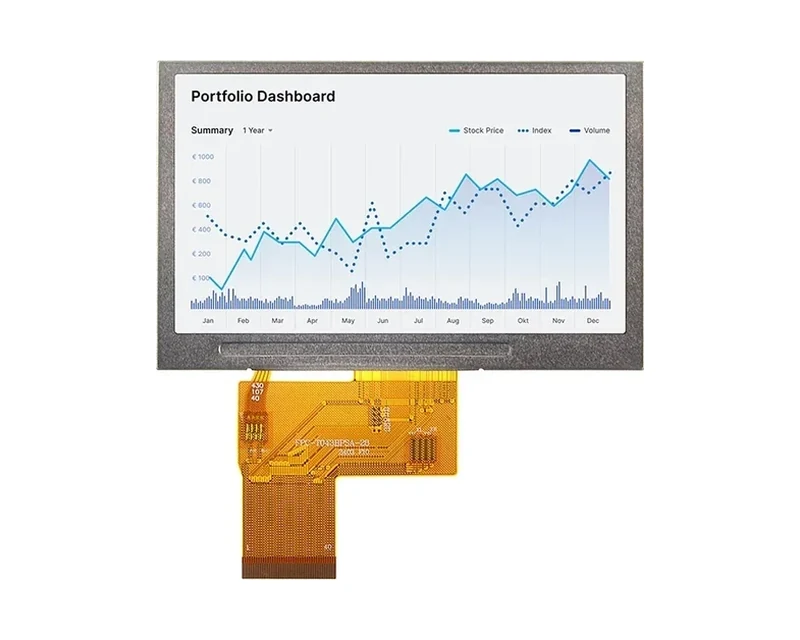
RG-T043BPSA-02
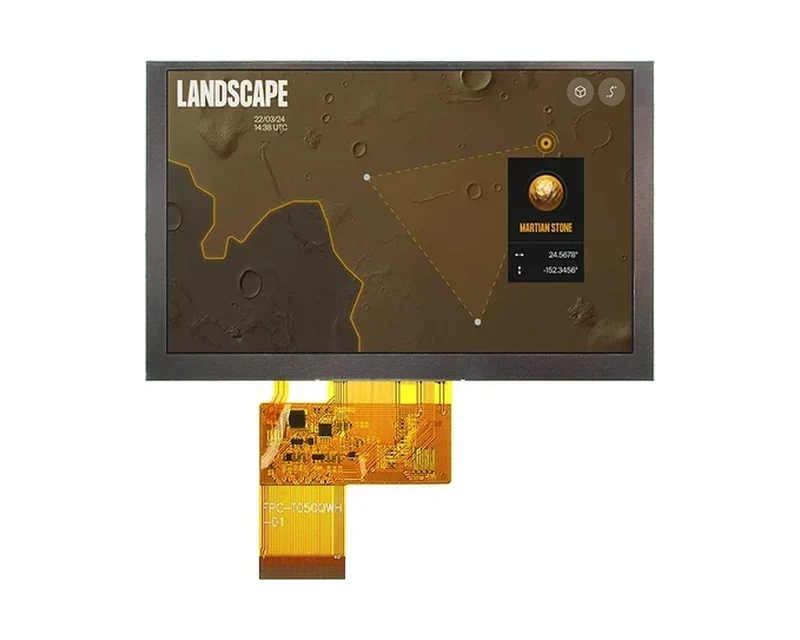
RG-T050QWH-05
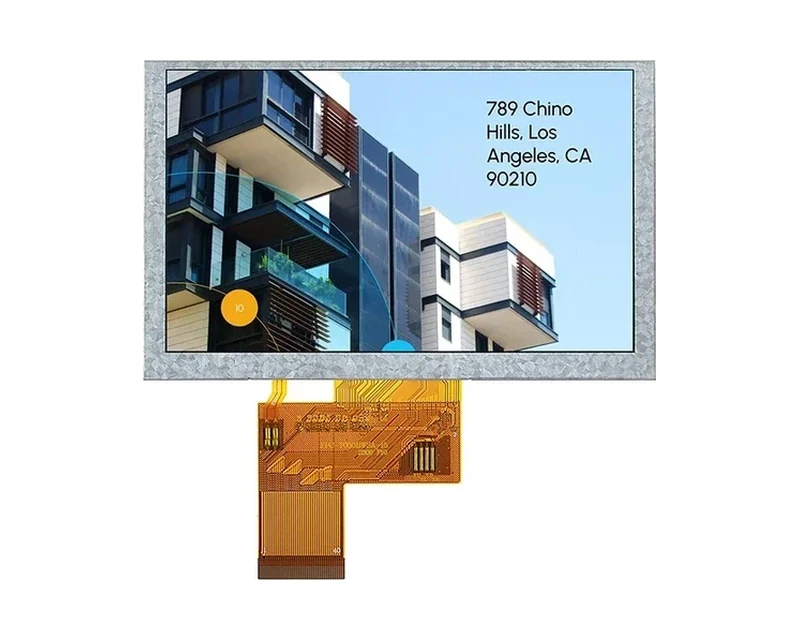
RG-T050BWSA-02
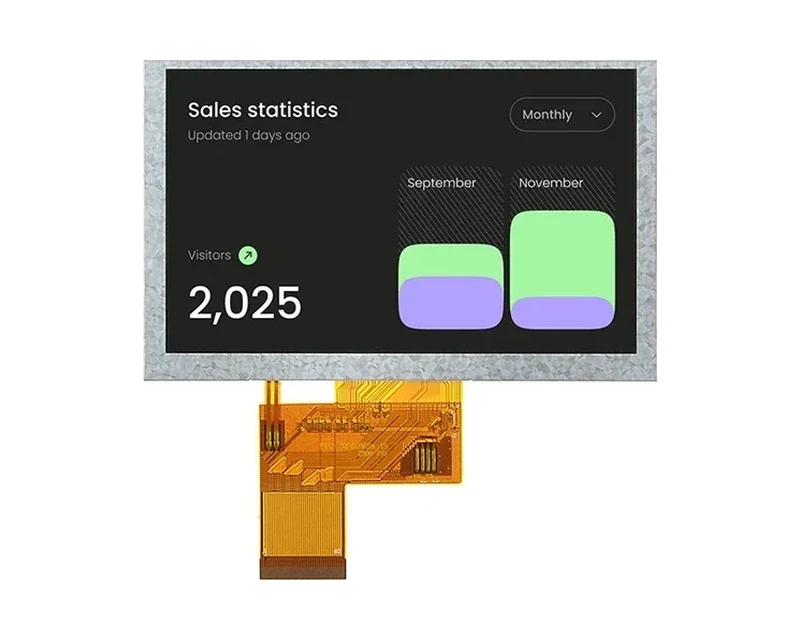
RG-T050BWSWA-02
RG-T070QWHW-02

RG-T070SWHWA-01
RG-T070BAHA-02
RG-T070BAHA-04
RG-T080QGH-09
RG-T101HIEWA-01

RG-T101HIEWA-03
RG-T101BFHA-01
RG-T104QXHA-03
RG-T121QXHA-01
RG-T121BIHA-01
RG-T156QFHWA-01
RG-T156BFHWA-02
RG-T185BFHWA-02
RG-T215BFHA-02
Can’t find the exact model you need?
This is a standard model, and our online catalog shows only part of what we build. We hold additional models not listed here, and we can adjust brightness, interface, touch or outline within an existing product family, or evaluate a fully custom solution. If this model does not fully match your requirements, please email your specifications to sales@odmlcd.com. We’ll help you identify the right part or assess a custom option.
FAQ
Are the modules sunlight readable?
Yes. RONEN offers a high-brightness line up to 1500 nits (23 standard models ≥1000 cd/m²) with optional optical bonding and transflective solutions that keep the image legible under direct sunlight. For outdoor HMI, pair high brightness with a bonded cover lens and anti-glare treatment.
Browse sunlight-readable displays or tell us your ambient-lux target on the contact page.
Do wide-temperature modules really operate -30°C to +85°C?
Yes. 33 standard models are rated for -30°C operation (storage down to -40°C, with the extended range qualified to +85°C / -40~+90°C on request). Each lot ships with temperature-cycle verification, and a third-party high-low temperature cycling report (≥500 cycles, -40~+90°C) is available on request.
See the wide-temperature display line.
Are they durable and high quality?
Cover-glass options reach 7H on the Mohs scale (≈9H by pencil-hardness test), and modules are built for industrial duty: 1.5 m drop test / IK08 impact rating on the covered versions. Every unit passes incoming and outgoing inspection against the spec sheet.
How long will a marine-grade model stay available?
RONEN keeps selected standards in production beyond 5 years and documents continuity, which matters for vessels kept in service for years.
Does the panel itself carry an IP rating?
No — IP ratings apply to the finished enclosure. The panel is a component inside a sealed front; what the display contributes is a flat, bondable surface and, where specified, a coated driver board. The ingress path that matters is the seam between the front glass and the housing, and that joint belongs to the enclosure design.
Will polarised sunglasses black out the screen?
They can, at a specific head angle, because an LCD emits linearly polarised light. A landscape-oriented panel goes dark when the glasses are rotated 90° to its polariser, which happens when the viewer tilts their head. It is a viewing-angle effect, not a fault; for helm use, check it with real sunglasses at the intended mounting angle before fixing the orientation.
What brightness do I need for a flybridge installation?
Start at 1000 cd/m² and treat 1500 cd/m² as the safe choice where the screen faces open sky or water glare. Below 1000 cd/m² even an anti-reflective front leaves the image grey at midday. Above 1500 cd/m² the thermal load in a sealed pod becomes the harder problem to solve.
How do I stop condensation inside the front glass?
Decide whether the cavity is sealed or vented, and be honest about the seal. A sealed cavity with desiccant works until the desiccant saturates; a breathable membrane vent follows ambient humidity and avoids trapping a moist pocket; a heater keeps the inner surface above the dew point on demand. Most marine installations use the vent plus a heater for cold starts.
Is 316 stainless really necessary for the bezel screws?
On a coastal installation, yes. 304 shows rust bloom within a season in salt spray, and the corrosion products stain the surrounding anodising. 316 is not immune either, but its molybdenum content raises the chloride pitting threshold enough to matter over a boat’s service life. Isolate stainless from aluminium to avoid a galvanic couple.